Skip the wiring. Keep the API.
Postgres, auth and sessions, a REST API with an OpenAPI document, and an MCP server, on your own domain. You did not write any of it, and you can still drive all of it from your terminal or your agent.
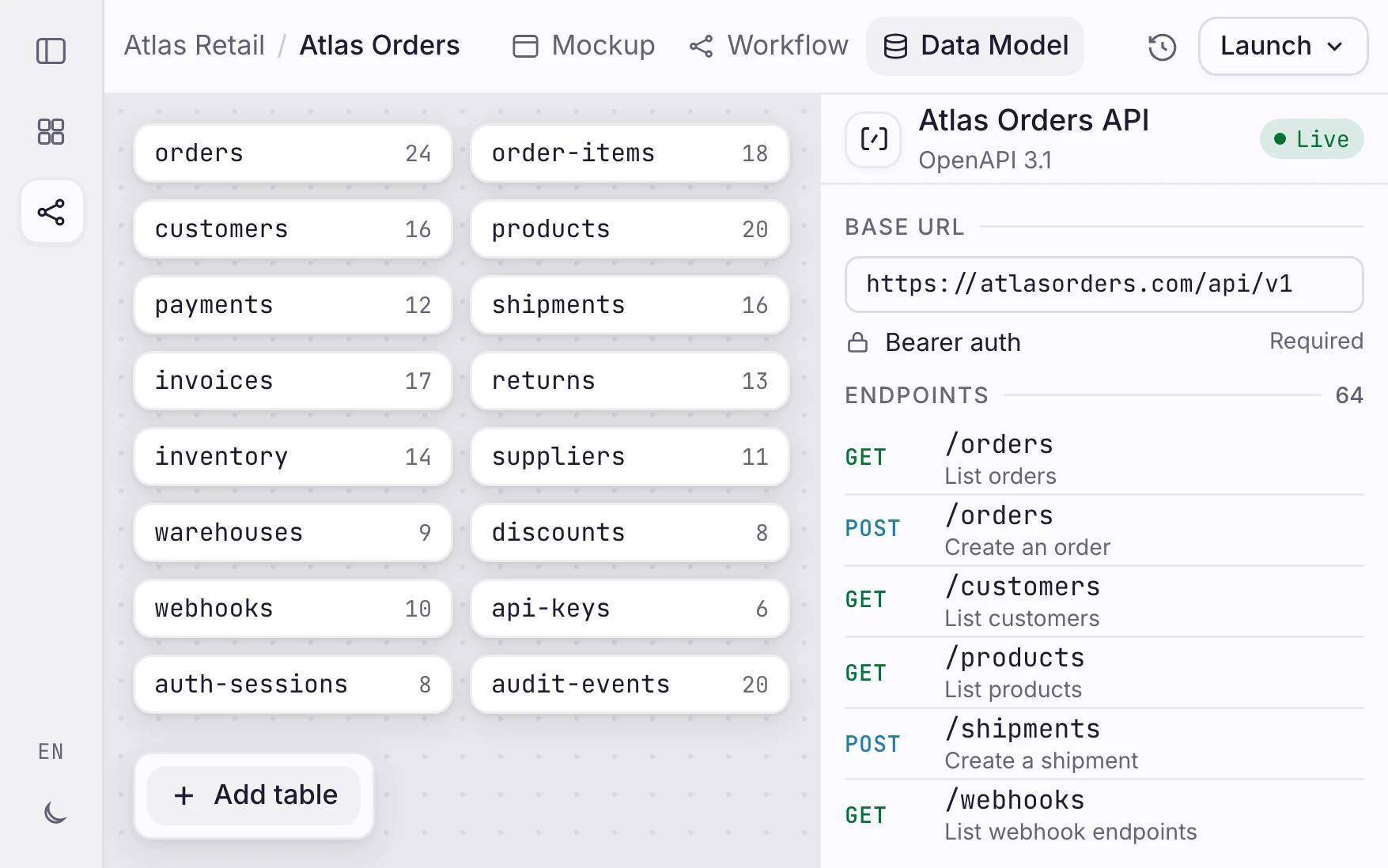
Atlas Orders backend preview
The Atlas Orders data model and API docs generated by Orbit.
Every app is a CLI, an API, and an MCP server.
The same three surfaces that build the app are how you operate it afterwards. There is no generated code to then maintain by hand.
Every table you draw gets its routes and its schema entry. An attribute marked private reaches none of them: not the response, not the OpenAPI document, not the agent.
You know this sprint.
None of that is the product. That is the whole point.
The product does not change. What the first week goes on does.
| To get one app running | What it costs you |
|---|---|
| Wiring it yourself | A week before the first real feature |
| A host plus four services | Four bills, four dashboards, and the glue between them |
| Orbit | Free to build. Your first deployment is free. Each one after that from $19 a month. |
Four things you could have running this week.
The internal tool nobody will staff
A real data model, sign-in, and a URL, without borrowing a sprint from the roadmap to get it.
A backend for a front end you have
Postgres, auth, and an auto-generated REST API your existing client can call today.
An app your agents can operate
Every app ships an MCP server, so Claude can read the data and run the workflows instead of guessing.
The side project that stalls at auth
This time it gets past sign-in, because sign-in is already there.
No surprise bill at the end of the month.
AI and hosting both show up in the usage view, split day by day. Nothing accumulates out of sight.
Orbit routes the AI
Drawn from a prepaid balance where one credit is one dollar. Credits never expire.
You bring your own
Connect the Claude or ChatGPT subscription you already pay for, through the Orbit CLI or MCP.
It stays drivable after it ships.
You built it, so you keep changing it, from the agent, the CLI, the API, or the browser. Hosting costs from $19 a month per deployment, and stopping one returns the unused days.
The same REST API and MCP server that built the app are how you operate it.
Read the schema instead.
Orbit is new and the developer case studies are not written. So rather than ask you to believe a testimonial: building is free. Read the schema, call the API, and judge it yourself.
What is not self-serve yet.
Developers, answered.
Can I build from Claude or my terminal?
Yes. Orbit exposes each app over MCP, a CLI, and a REST API, so you can build and drive it from Claude, your terminal, or code.
What backend do I get?
A Postgres database, auth and sessions, server workflows, and an auto-generated REST API, published on your own domain.
Do I get the source code?
No source-code download in the product. Orbit runs the backend for you; you drive it through the REST API and its MCP server. If you need the code or a repository for a client, ask and we set it up by hand.
Can agents operate the app?
Yes. Each app ships an MCP server alongside its REST API, so an agent can read data, call workflows, and change the app the same way you do.
Can I bring my own AI subscription?
Yes. Connect the Claude or ChatGPT subscription you already pay for through the Orbit CLI or MCP, and that usage costs nothing to Orbit.
What if I outgrow it?
The data sits in Postgres behind a REST API, and code handover is available on request, so what you built is a starting point rather than a dead end.
What does it cost?
Building is free and your first deployment is free. Each one after that starts at $19 a month. AI can run from prepaid Orbit credits, or cost nothing to Orbit if you bring your own Claude or ChatGPT subscription.
What if Orbit shuts down?
You get the code, your data, and the database, or help moving to a platform of your choice.