Sautez le câblage. Gardez l’API.
Postgres, l’authentification et les sessions, une API REST avec un document OpenAPI, et un serveur MCP, sur votre propre domaine. Vous n’avez rien écrit de tout cela, et vous pouvez quand même tout piloter depuis votre terminal ou votre agent.
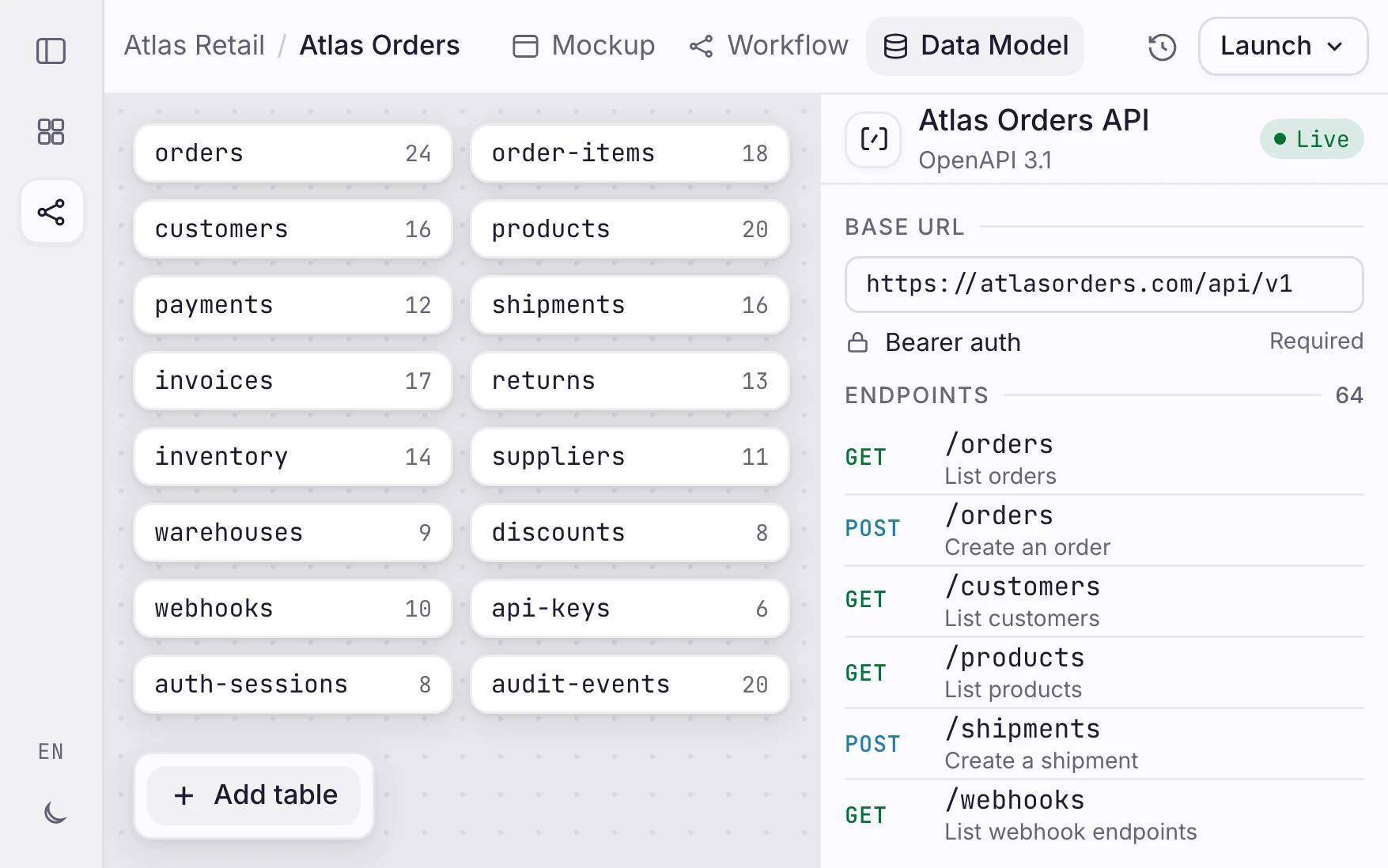
Aperçu du backend Atlas Orders
Le Data Model et la doc d’API d’Atlas Orders générés par Orbit.
Chaque app est un CLI, une API et un serveur MCP.
Les trois mêmes surfaces qui créent l’app sont celles par lesquelles vous l’exploitez ensuite. Il n’y a pas de code généré à maintenir ensuite à la main.
Chaque table que vous dessinez obtient ses routes et son entrée de schéma. Un attribut marqué privé n’atteint aucun d’eux : ni la réponse, ni le document OpenAPI, ni l’agent.
Vous connaissez ce sprint.
Rien de tout cela n’est le produit. C’est tout l’intérêt.
Le produit ne change pas. Ce à quoi part la première semaine, si.
| Pour faire tourner une app | Ce que cela vous coûte |
|---|---|
| Le câbler soi-même | Une semaine avant la première vraie fonctionnalité |
| Un hébergeur plus quatre services | Quatre factures, quatre tableaux de bord, et la colle entre les deux |
| Orbit | Gratuit à créer. Votre premier déploiement est gratuit. Chacun ensuite à partir de 19 $ par mois. |
Quatre choses que vous pourriez faire tourner cette semaine.
L’outil interne que personne ne veut staffer
Un vrai Data Model, la connexion et une URL, sans emprunter un sprint à la feuille de route pour l’obtenir.
Un backend pour un front que vous avez
Postgres, l’authentification et une API REST générée que votre client existant peut appeler dès aujourd’hui.
Une app que vos agents savent exploiter
Chaque app livre un serveur MCP : Claude peut lire les données et exécuter les Workflows au lieu de deviner.
Le projet perso qui cale à l’authentification
Cette fois il passe la connexion, parce que la connexion est déjà là.
Pas de facture surprise à la fin du mois.
L’IA et l’hébergement apparaissent tous deux dans le suivi d’usage, ventilés jour par jour. Rien ne s’accumule hors de vue.
Orbit achemine l’IA
Puisée dans un solde prépayé où un crédit vaut un dollar. Les crédits n’expirent pas.
Vous apportez la vôtre
Connectez l’abonnement Claude ou ChatGPT que vous payez déjà, via le CLI Orbit ou MCP.
Elle reste pilotable après la livraison.
Vous l’avez créée, donc vous continuez à la changer, depuis l’agent, le CLI, l’API ou le navigateur. L’hébergement coûte à partir de 19 $ par mois et par déploiement, et en arrêter un vous rend les jours non utilisés.
La même API REST et le même serveur MCP qui ont créé l’app sont ceux par lesquels vous l’exploitez.
Lisez plutôt le schéma.
Orbit est récent et les études de cas développeurs ne sont pas écrites. Alors plutôt que de vous demander de croire un témoignage : créer est gratuit. Lisez le schéma, appelez l’API, et jugez vous-même.
Ce qui n’est pas encore en libre-service.
Les devs, questions et réponses.
Puis-je créer depuis Claude ou mon terminal ?
Oui. Orbit expose chaque app en MCP, en CLI et en API REST : vous pouvez la créer et la piloter depuis Claude, votre terminal ou du code.
Quel backend est-ce que j’obtiens ?
Une base Postgres, l’authentification et les sessions, des Workflows serveur, et une API REST générée, publiée sur votre propre domaine.
Est-ce que j’obtiens le code source ?
Pas de téléchargement du code source dans le produit. Orbit fait tourner le backend pour vous ; vous le pilotez par l’API REST et son serveur MCP. Si vous avez besoin du code ou d’un dépôt pour un client, demandez et nous le mettons en place à la main.
Les agents peuvent-ils exploiter l’app ?
Oui. Chaque app livre un serveur MCP à côté de son API REST : un agent peut lire les données, appeler les Workflows et modifier l’app comme vous le faites.
Puis-je apporter mon propre abonnement d’IA ?
Oui. Connectez l’abonnement Claude ou ChatGPT que vous payez déjà, via le CLI Orbit ou MCP, et cet usage ne coûte rien à Orbit.
Et si je le dépasse ?
Les données sont dans Postgres derrière une API REST, et la remise du code est possible sur demande : ce que vous avez créé est un point de départ plutôt qu’une impasse.
Combien ça coûte ?
Créer est gratuit et votre premier déploiement est gratuit. Chacun ensuite démarre à 19 $ par mois. L’IA peut tourner sur des crédits Orbit prépayés, ou ne rien coûter à Orbit si vous apportez votre abonnement Claude ou ChatGPT.
Et si Orbit ferme ?
Vous récupérez le code, vos données et la base, ou de l’aide pour migrer vers la plateforme de votre choix.