Build it anyway.
You have been describing this for a year. Now you compose it: screens, a Postgres database, sign-in, and a live URL on your own domain.
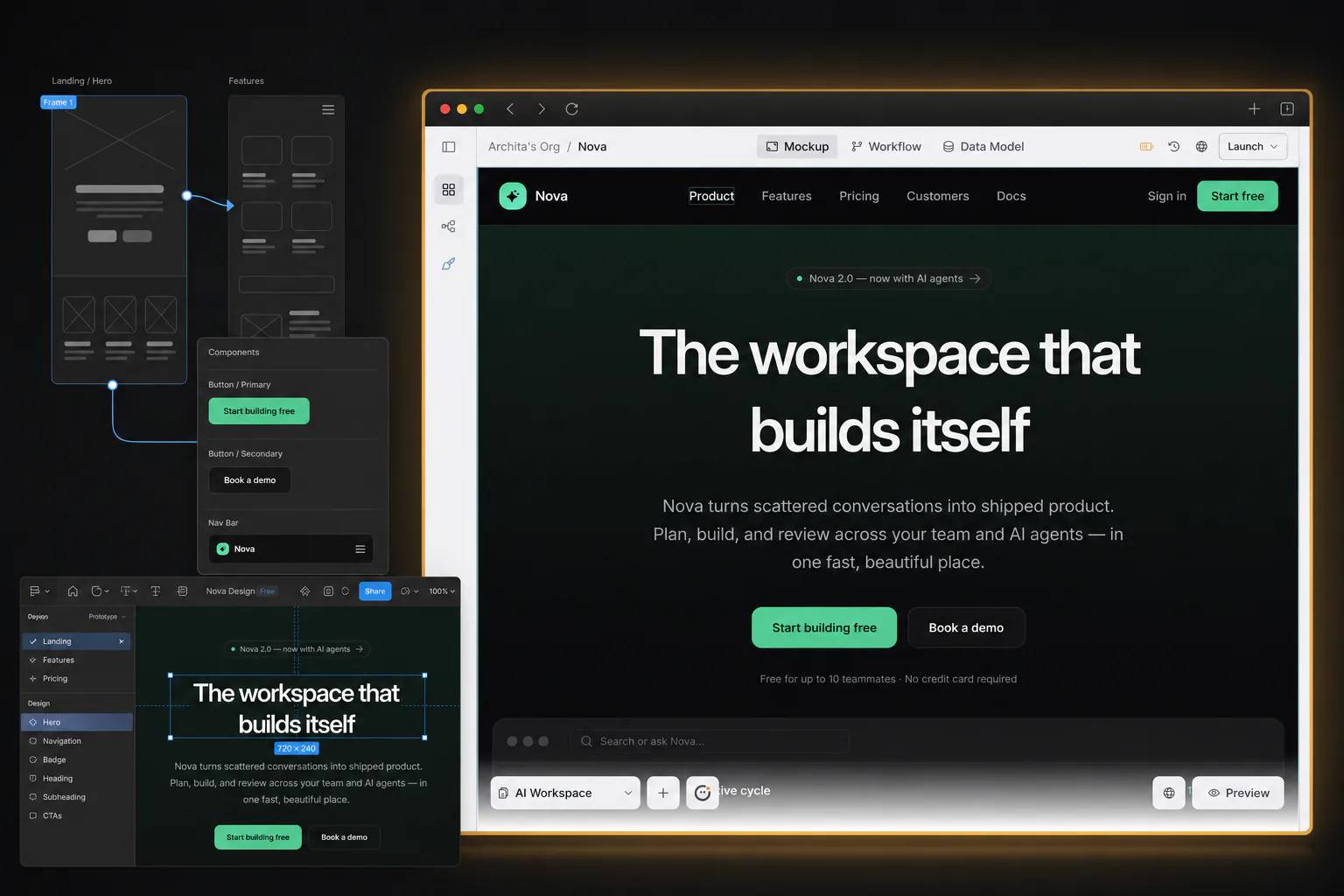
Founder app preview
Open the founder app build and preview image at full size.
You do not have to know yet.
The idea is a year old and still half-formed. That is what Explore is for: the notes, the links and the pitch you typed at 1am, on one canvas, before anything is built.
Nothing on the board costs anything, and nothing on it is a commitment. The first thing you build is the thing you already decided on.
You know this month.
Every one of those is a stand-in for the app. That is the whole point.
Your runway does not change. What you get for it does.
| To get the first version live | What it costs you |
|---|---|
| A technical co-founder | A permanent share of the company |
| Hiring a developer | A salary spent before you know it works |
| Orbit | Free to build. Your first deployment is free. Each one after that from $19 a month. |
Four things you could have live this week.
The MVP itself
Sign-up, your data, and a REST API, running on your domain. The product that has sat in a deck for a year.
A waitlist that does something
Not a form feeding a spreadsheet. Sign-in, real records, and a first-run flow your early users move through.
The tool you run the company on
The spreadsheet you and two others fight over, rebuilt with a data model, sign-in, and a workflow you can edit.
The one thing that closes the pilot
A customer says yes if it does one specific thing. Build that this week instead of promising it next quarter.
You can still plan the runway.
AI and hosting both show up in the usage view, split day by day. The month is a number you can read today, not one that arrives after you have spent it.
Orbit routes the AI
Drawn from a prepaid balance where one credit is one dollar. Credits never expire.
You bring your own
Connect the Claude or ChatGPT subscription you already pay for. Nothing extra to sign up for.
Nothing is frozen at launch.
You built it, so you keep changing it. Hosting costs from $19 a month per deployment, and stopping one returns the unused days.
What your users try next week is a change you make on Tuesday, not a release you plan a quarter around.
Your logo is not on this page yet.
Orbit is new and the founder case studies are not written. So rather than ask you to believe a testimonial: building is free, and your first live app is free on your own domain. Build the thing and judge it yourself.
What is not self-serve yet.
Founders, answered.
Do I need a technical co-founder?
No. You can scope, build, change, and launch from one workspace on your own.
Is this a real product or a prototype?
Real. Each launched app has its own Postgres database, sign-in, access rules, workflows, hosting, HTTPS, and domain.
What does it cost to launch?
Building is free and your first deployment is free. Each one after that starts at $19 a month, charged for the hours it is up. AI can run from prepaid Orbit credits, or cost nothing to Orbit if you bring your own Claude or ChatGPT subscription.
Can I put it in front of customers and investors?
Yes. It runs on your own domain, so what they open is your product, not a preview link with someone else's name on it.
What do I own, and what can I hand over?
The app, its data, and the domain, reachable over a REST API. Orbit runs the app, so the source is not a download in the product, but if your contract or your investors need the code or a GitHub repo, ask and we set it up.
What if I hire developers later?
Then hire them. The data sits in Postgres behind a REST API they can work against on their first day. There is no source-code download in the product, so if you need the code or a repository for a client, ask and we set it up by hand.
What if the idea does not work?
You cannot get stuck holding the bill. Charging follows the live deployment, so taking the app down ends it and the unused days return to your balance.
What if Orbit shuts down?
You get the code, your data, and the database, or help moving to a platform of your choice.