One agent, from your idea to the app.
You turn your idea into a working app. The agent researches what is missing, plans the build, creates the data, screens, and workflows, then checks everything against your real data before marking it done.
Free to build. Your first live app is free too, on your own domain.
The agentic loop
One loop, the whole build.
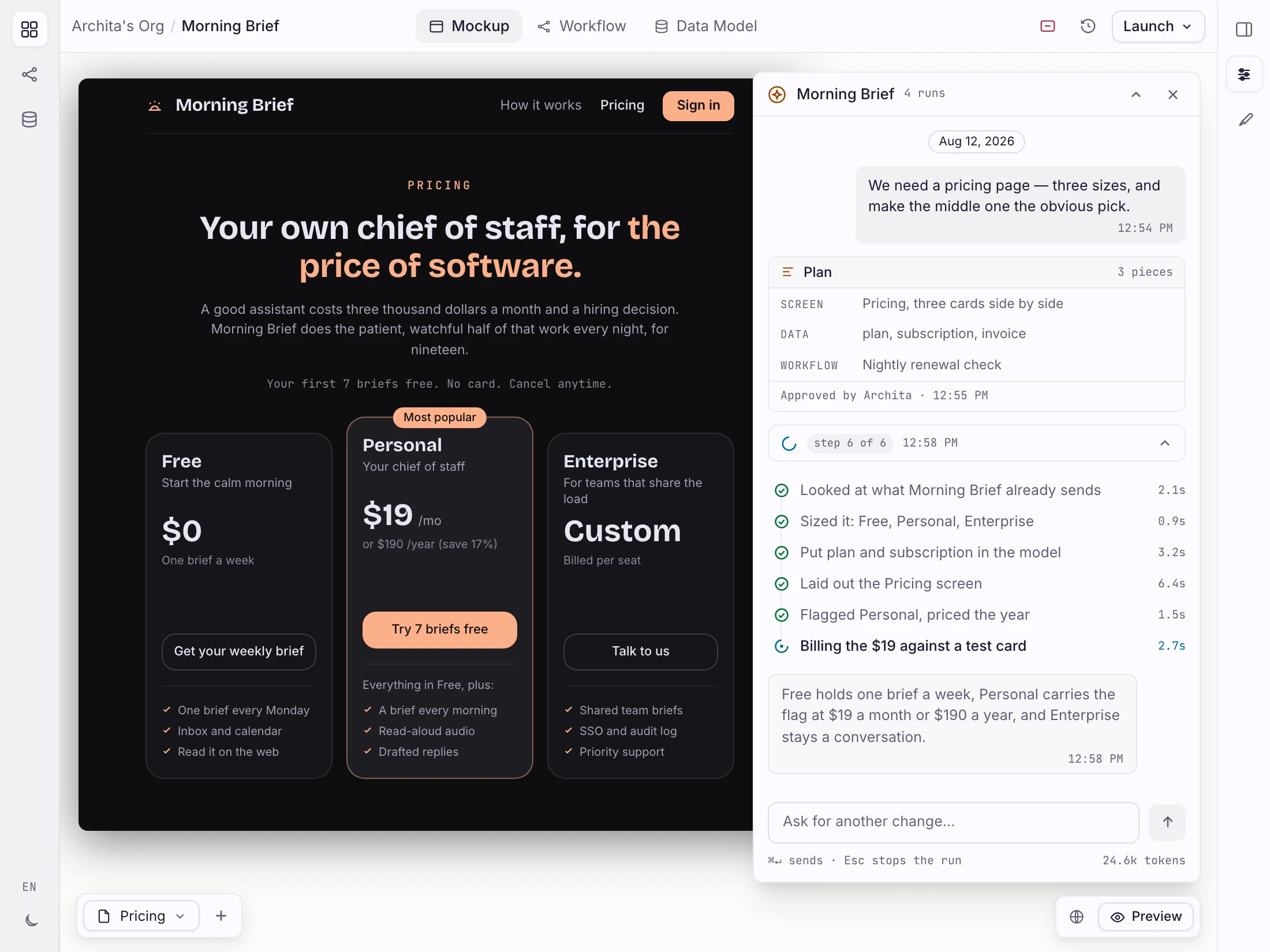
The cycle is simple: plan what is needed, gather the right context, compose the app, then check it.
Plans the build
It reads your rough idea and works out what to build.
Gathers the pieces
It pulls the building blocks, the data shape, and the screens the app needs.
Composes every surface
The data, the workflows, and the screens, assembled into one working app.
Checks its own work
It runs the app and checks the result against your live data before it calls anything done.
What it builds
A working app, every time.
You end up with a real app, ready to use. It includes a Postgres database, working screens, backend logic, and managed hosting, so it is ready when users arrive.
Straight answers
About the build.
Is this only code generation?
No. It is one agent runtime: it plans the build, gathers the pieces, composes the app, and checks its work against your live data. The same runtime researches your idea, shapes the plan, and can run inside your finished app as a step in a workflow.
What if my idea is vague?
That is the point. The harness plans from a rough idea, fills in the pieces, and shows you what it built. You take it from there, editing any surface by hand or by asking.
Can I change what it builds?
Yes. It shows its plan and its work as it goes, and you can stop it at any point. Edit any surface after, by hand or by asking.
Does it stop at a demo?
No. It builds on a Postgres database and managed hosting, so what comes out is a working app, not a preview that breaks.
How do I know the app works?
Before it calls anything done, the agent runs your app and checks the result against live data. Guards stop it from looping or running away, and a long build picks up where it left off if anything restarts.
Start
Start with a rough idea.
Describe it in a sentence. The harness plans it, builds it, and shows you a working app.

 Made in Orbit